How to Assess Teaching Quality During a School Visit: 8 Things Parents Should Check
Choosing the right school is one of the most important decisions parents make for their children. While school infrastructure, classrooms, facilities and academic results are important, the quality of teaching deserves equal attention.
A school visit gives parents an opportunity to understand how teachers interact with students, explain concepts, encourage participation and support children who need additional help.
But how can you assess teaching quality during a school visit?
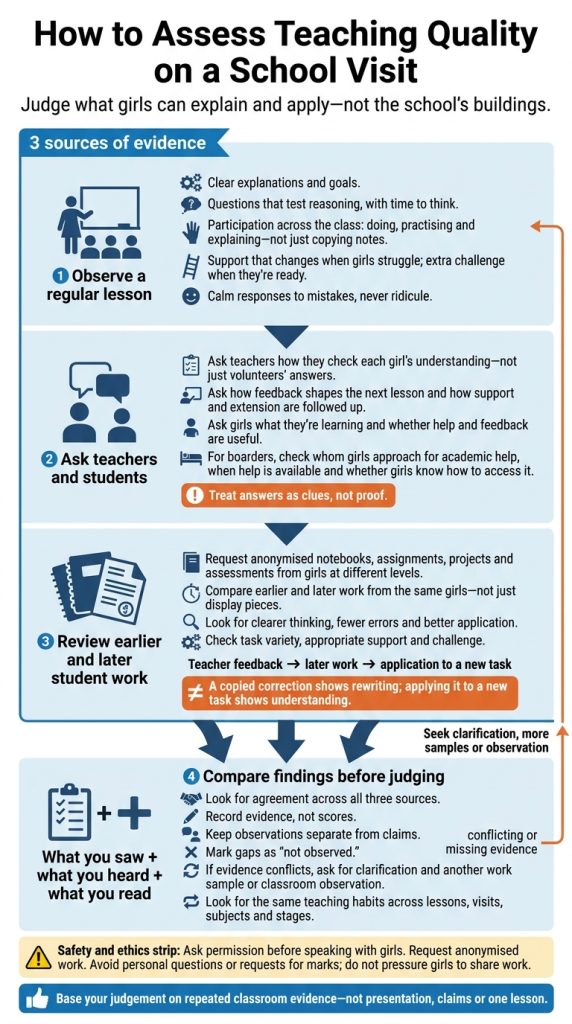
Instead of judging a school only by its buildings or presentations, look for evidence of effective teaching and student learning. Observe a classroom, speak with teachers, understand the assessment process and review examples of student work.
Here are eight important things parents should check when visiting a school.
1. Observe How Teachers Explain Concepts
Good teaching is not just about completing the syllabus. It is about helping students understand concepts and apply what they learn.
During a classroom observation, notice whether teachers:
-
Explain difficult topics in simple language.
-
Use examples from everyday life.
-
Encourage students to ask questions.
-
Check whether students have understood the lesson.
-
Explain concepts in different ways when students struggle.
A useful question to ask is: Can students explain the concept in their own words, or are they only repeating what the teacher said?
Understanding matters more than memorising answers.
2. Check Student Participation in the Classroom
An effective classroom encourages students to participate rather than remain passive listeners.
Observe whether students get opportunities to answer questions, discuss ideas, solve problems and participate in classroom activities.
Look for these signs:
-
Different students get opportunities to participate.
-
Teachers encourage questions and discussions.
-
Students are comfortable sharing their ideas.
-
Classroom activities involve practical thinking.
-
Teachers respond positively to student mistakes.
What to look out for: If only a few students answer every question while most of the class remains inactive, ask how teachers encourage wider participation.
3. Understand How Teachers Support Different Learning Needs
Every child learns at a different pace. Some students understand a topic quickly, while others may need additional explanations, practice or guidance.
During your school visit, ask how teachers identify students who are facing difficulties and what support is provided.
You can ask:
-
How do teachers identify learning gaps?
-
Is additional academic support available?
-
How are students encouraged to improve?
-
Do advanced learners receive challenging tasks?
-
How do teachers track individual progress?
A supportive learning environment should help students improve without making them feel discouraged or left behind.
4. Ask How Student Progress Is Evaluated
Examinations are one way to measure academic performance, but they should not be the only method used to understand a student’s learning.
Ask the school how it evaluates student progress throughout the academic year.
Find out whether the assessment process includes:
-
Class tests and periodic assessments.
-
Assignments and homework.
-
Projects and practical activities.
-
Classroom participation.
-
Feedback and improvement plans.
For a CBSE-affiliated school, parents can also ask how classroom activities encourage conceptual understanding, critical thinking and problem-solving.
The goal is to understand whether assessments help teachers identify learning gaps and guide students towards improvement.
5. Review Student Notebooks and Assignments
Student work can provide useful evidence of how teaching and learning happen in everyday classrooms.
With the school’s permission, ask to see examples of notebooks, assignments, projects or assessed work.
Check for:
-
Regular completion of classroom work.
-
Clear and understandable explanations.
-
Teacher feedback beyond marks or ticks.
-
Corrections that help students understand mistakes.
-
Improvement in work over time.
-
A balance of written, creative and practical tasks.
Do not judge teaching quality by one perfect notebook. Look for consistency across different students and subjects.
6. Check the Learning Environment and Academic Facilities
The classroom environment and academic resources can support effective teaching when they are used meaningfully.
During your visit, explore the learning spaces and ask how students use them as part of their education.
Some useful areas to observe include:
-
Smart classrooms and audio-visual learning resources.
-
Science and mathematics laboratories.
-
Computer laboratories.
-
Language-learning facilities.
-
Library and reading resources.
At Dundlod Public School, parents can explore the school’s academic facilities to learn more about its teaching resources, laboratories, library and learning spaces.
Remember that facilities alone do not guarantee quality education. What matters is how effectively teachers use these resources to improve student understanding.
7. Understand Teacher-Parent Communication
A child’s education improves when parents and teachers communicate regularly and work together.
During your visit, ask how the school keeps parents informed about academic performance, classroom participation and areas requiring improvement.
Consider asking:
-
How often are parent-teacher meetings organised?
-
How are academic concerns communicated?
-
Can parents discuss a child’s learning difficulties with teachers?
-
How does the school share progress updates?
-
Who should parents contact if they have a concern?
Clear communication helps parents understand their child’s development and provide support at home.
8. Look Beyond Exam Results and Overall Presentation
Academic results are important, but they do not tell the complete story of a student’s educational experience.
A good school should also encourage confidence, curiosity, discipline, creativity, teamwork and independent thinking.
During your visit, look for evidence of:
-
Students participating in academic and co-curricular activities.
-
Opportunities to develop communication skills.
-
Sports and extracurricular participation.
-
Respectful interactions between teachers and students.
-
Activities that encourage leadership and responsibility.
Try to understand how the school balances academic learning with the overall development of students.
School Visit Checklist for Parents
Use this simple checklist while visiting a school. Record what you observe and note any questions that need further clarification.
| What to Check | What to Observe |
|---|---|
| Teaching methods | Clear explanations and practical examples |
| Student participation | Students ask questions and take part |
| Individual support | Help for students who need additional guidance |
| Assessment methods | Regular evaluation and useful feedback |
| Student work | Consistency, corrections and improvement |
| Academic facilities | Resources that support classroom learning |
| Parent communication | Clear updates and accessible teachers |
| Overall development | Sports, activities, confidence and life skills |
Helpful tip: If you cannot observe a regular classroom lesson during your visit, ask whether the school can arrange another suitable time. You can also review anonymised student work and discuss teaching methods with the academic coordinator.
Conclusion: Choose a School Based on Learning, Not Just Appearance
A school visit should help parents understand what happens beyond the admission brochure and campus presentation.
Observe classroom teaching, ask meaningful questions, review student work and understand how the school supports different learning needs. Look for consistent evidence of student progress rather than relying on a single impressive lesson or academic result.
At Dundlod Public School, parents can explore the school’s academic facilities, learn about its curriculum and contact the school to plan a visit and discuss admission-related queries.
Choosing the right school begins with asking the right questions.
Frequently Asked Questions (FAQs)
1. How can parents assess teaching quality during a school visit?
Parents should observe classroom explanations, student participation, teacher-student interaction and the way teachers respond to questions. Reviewing student work and understanding assessment methods can also provide useful insights.
2. What questions should parents ask teachers during a school visit?
Parents can ask about teaching methods, student assessments, additional academic support, homework, individual progress and parent-teacher communication.
3. Are good exam results enough to judge a school’s teaching quality?
No. Exam results are important, but parents should also consider conceptual understanding, classroom participation, practical learning, student confidence and overall development.
4. What should parents look for in a classroom?
Look for clear teaching, active student participation, respectful communication, opportunities to ask questions and a positive approach towards mistakes and learning difficulties.
5. Why should parents review student notebooks and assignments?
Notebooks and assignments can show how regularly students practise, how teachers provide feedback and whether students are improving over time.
6. Should parents check academic facilities during a school visit?
Yes. Libraries, laboratories, computer rooms and smart classrooms can support learning. Parents should also ask how frequently and effectively students use these facilities.
7. How important is communication between teachers and parents?
Regular communication helps parents understand academic progress, identify concerns early and work with teachers to support their child’s development.