School Timetable Worksheets for Classes 3–5: 6 Activities to Improve Learning Skills
A school timetable is an essential part of every student’s academic journey. It helps children understand their daily routine, organise their studies and develop effective time-management habits. Learning how to read a school timetable also improves observation, logical thinking, reading comprehension and basic mathematical skills.
For students in Classes 3–5, timetable-reading exercises provide an excellent opportunity to learn through practical activities. By identifying subjects, understanding lesson timings, calculating break durations and comparing daily schedules, children gradually become more organised and independent learners.
At Dundlod Public School, we believe that meaningful education goes beyond textbooks and examinations. Classroom activities and practical exercises help students develop essential skills that support their academic growth and everyday lives.
In this article, we have included six interesting school timetable worksheets with examples, practice questions and answers that teachers and parents can use to make learning more engaging.
Why Is Learning to Read a School Timetable Important?
Understanding a school timetable helps students become familiar with their daily academic routine. It teaches children how to plan their day, prepare their study materials and manage different activities.
Some important benefits include:
-
Better Time Management: Students learn to understand lesson timings, breaks and daily schedules.
-
Improved Reading Skills: Reading timetable rows, columns and headings develops comprehension.
-
Logical Thinking: Comparing schedules and identifying changes encourages problem-solving.
-
Better Organisation: Children learn to prepare their books and stationery according to their subjects.
-
Mathematical Understanding: Calculating lesson durations and break times strengthens basic mathematical skills.
-
Independent Learning: Students become more confident in managing their school routines.
These skills are valuable for students throughout their academic journey. Understanding the CBSE curriculum and developing strong learning habits from an early age can further support their academic progress.
Sample Weekly School Timetable for Students
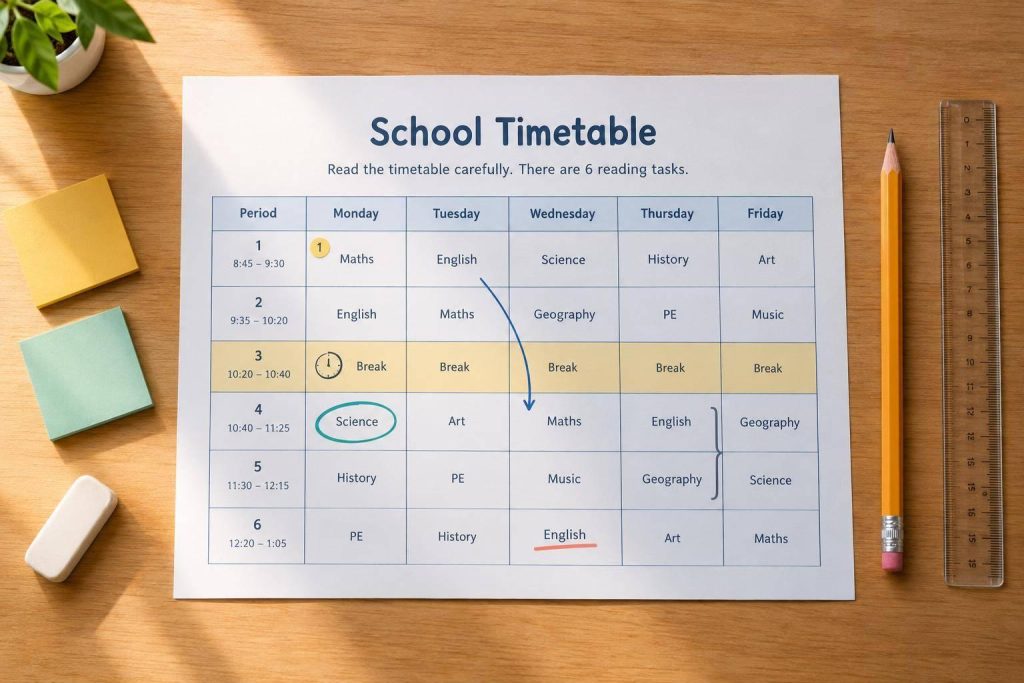
Before beginning the exercises, let’s understand a sample weekly school timetable.
Students can use this timetable to complete all six activities given below.
| Time / Activity | Monday | Tuesday | Wednesday | Thursday | Friday |
|---|---|---|---|---|---|
| Assembly (8:30–8:45 AM) | Assembly | Assembly | Assembly | Assembly | Assembly |
| Period 1 (8:45–9:30 AM) | English | Hindi | English | Mathematics | English |
| Period 2 (9:30–10:15 AM) | Mathematics | Mathematics | Science | Hindi | Mathematics |
| Short Break (10:15–10:35 AM) | Break | Break | Break | Break | Break |
| Period 3 (10:35–11:20 AM) | Hindi | English | Mathematics | English | Science |
| Period 4 (11:20 AM–12:05 PM) | Science | Social Science | Hindi | Science | Social Science |
| Lunch (12:05–12:45 PM) | Lunch | Lunch | Lunch | Lunch | Lunch |
| Period 5 (12:45–1:30 PM) | Art | Science | Social Science | Computer Studies | Science |
| Period 6 (1:30–2:15 PM) | Physical Education | Computer Studies | Art | Physical Education | Art |
Each lesson lasts 45 minutes. Assembly, short break and lunch are separate activities and are not counted as regular lesson periods.
Now, let’s use this timetable to complete the following six activities.
1. Find a Subject in the Timetable
Look carefully at the weekly timetable and identify all the days when Art is scheduled.
Answer the following questions:
-
On which days is Art taught?
-
During which period is Art scheduled on Monday?
-
How many Art lessons are there during the entire week?
-
At what time does the Art lesson begin on Friday?
Learning Objective: This activity helps students understand how to locate information using timetable rows and columns.
2. Arrange Lessons in the Correct Order
Look at Tuesday’s timetable and identify the subjects in the order they appear.
Write the correct sequence of subjects for Periods 1–4.
-
Hindi: ______
-
Mathematics: ______
-
English: ______
-
Social Science: ______
Now answer:
-
Which subject is taught during the first period on Tuesday?
-
Which subject comes immediately after the short break?
-
Which subject is scheduled during the fourth period?
-
Which subject is taught immediately after lunch?
Learning Objective: Students practise sequencing information and following a daily school schedule.
3. Understand School Break Times
Breaks are an important part of a student’s school routine. Understanding their duration helps children develop basic time-calculation skills.
Look at the sample timetable and complete the following:
Short Break
-
Starting Time: __________
-
Ending Time: __________
-
Total Duration: __________ minutes
Lunch Break
-
Starting Time: __________
-
Ending Time: __________
-
Total Duration: __________ minutes
Now answer:
-
Which subject is taught immediately after the short break on Monday?
-
Which subject is taught immediately after lunch on Monday?
-
How many minutes are there between the end of the short break and the beginning of lunch?
Learning Objective: This activity develops time calculation and helps students understand the duration of different school activities.
4. Complete the Missing Timetable Entries
Read the weekly timetable carefully and fill in the missing information.
| Question | Missing Information | Your Answer |
|---|---|---|
| A | Wednesday, Period 2 | ______ |
| B | Tuesday, Period 2 | ______ |
| C | Thursday, Period 3 | ______ |
| D | Ending time of the short break | ______ |
Use the timetable headings and lesson timings to find the correct answers.
Teachers can make this exercise more challenging by hiding additional entries and asking students to identify them using the available information.
Learning Objective: This activity develops observation, memory and problem-solving skills.
5. Compare Two School Timetables
Schools sometimes make changes to their daily schedules because of special activities, examinations or other academic requirements.
Let’s compare the original and revised Monday timetables.
| Period | Original Timetable | Revised Timetable |
|---|---|---|
| Period 1 | English | Hindi |
| Period 2 | Mathematics | Mathematics |
| Short Break | Short Break | Short Break |
| Period 3 | Hindi | English |
| Period 4 | Science | Art |
| Lunch | Lunch | Lunch |
| Period 5 | Art | Science |
| Period 6 | Physical Education | Physical Education |
Answer the following questions:
-
Which subject has moved from Period 1 to Period 3?
-
Which subject has moved from Period 3 to Period 1?
-
Which subject has replaced Science in Period 4?
-
Which subject has replaced Art in Period 5?
-
Name two subjects that have remained in the same periods.
-
Why is it important for students to check an updated timetable?
Learning Objective: Students learn to compare information, identify differences and understand timetable changes.
6. Answer in Complete Sentences
Use the weekly timetable to answer the following questions.
-
At what time does Mathematics begin on Tuesday?
-
Which subject is taught immediately after Hindi on Thursday?
-
How many Science lessons are scheduled on Monday and Friday? Which day has more Science lessons?
-
If the Monday timetable changes, why is it important to check which books and learning materials are required for the day?
-
How can following a school timetable help students become more organised?
Encourage students to write their answers in complete sentences rather than single words.
Learning Objective: This activity improves reading comprehension, written communication and independent thinking.
Answer Key: School Timetable Worksheets
Teachers and parents can use these answers to evaluate students’ work.
Activity 1: Find a Subject
-
Art is taught on Monday, Wednesday and Friday.
-
Art is scheduled during Period 5 on Monday.
-
There are three Art lessons during the week.
-
The Friday Art lesson begins at 1:30 PM.
Activity 2: Arrange Lessons
Tuesday’s subjects appear in this order:
-
Hindi
-
Mathematics
-
English
-
Social Science
Additional answers:
-
First period: Hindi.
-
Immediately after the short break: English.
-
Fourth period: Social Science.
-
Immediately after lunch: Science.
Activity 3: Understand Break Times
Short Break: 10:15 AM to 10:35 AM – 20 minutes.
Lunch Break: 12:05 PM to 12:45 PM – 40 minutes.
Additional answers:
-
After the short break on Monday: Hindi.
-
After lunch on Monday: Art.
-
Time between the end of the short break and lunch: 90 minutes.
Activity 4: Complete the Timetable
-
A: Science.
-
B: Mathematics.
-
C: English.
-
D: 10:35 AM.
Activity 5: Compare Timetables
-
English has moved from Period 1 to Period 3.
-
Hindi has moved from Period 3 to Period 1.
-
Art has replaced Science in Period 4.
-
Science has replaced Art in Period 5.
-
Mathematics and Physical Education have remained in the same periods.
-
Checking an updated timetable helps students prepare the correct books and learning materials.
Activity 6: Complete Sentences
-
Mathematics begins at 9:30 AM on Tuesday.
-
English is taught immediately after Hindi on Thursday.
-
Monday has one Science lesson, while Friday has two. Friday has one more Science lesson.
-
Students should check the revised timetable and prepare the books and materials required for the scheduled subjects.
-
Following a school timetable helps students plan their activities, manage their time and become more responsible learners.
How Can Students Use Timetables in Their Daily School Routine?
The skills developed through timetable-reading activities can be applied to everyday school life.
Students can develop better habits by:
-
Checking their daily timetable before leaving for school.
-
Packing the correct books and notebooks.
-
Keeping track of lesson timings and breaks.
-
Preparing for upcoming classroom activities.
-
Following timetable changes announced by teachers.
-
Completing homework and revision according to a planned schedule.
Parents can also encourage children to read their school timetable regularly. This simple habit can help them become more responsible, organised and confident.
Importance of Practical Learning in School Education
Education is not limited to reading textbooks or preparing for examinations. Students also need opportunities to apply what they learn in real-life situations.
Activities such as timetable reading, classroom discussions, group assignments, quizzes and worksheets help children develop a deeper understanding of different concepts.
At Dundlod Public School, Dundlod, we believe in encouraging students to develop academic knowledge, independent thinking and essential life skills through meaningful learning experiences.
Our academic facilities support a learning environment where students can explore concepts, participate in activities and develop their abilities beyond regular classroom lessons.
For students living on campus, a structured daily routine is also important. Parents can explore our school hostel facilities to learn more about the residential environment and student